3D Printing or CNC Machining: Which Suits Your Part?
Buyer Guides · 9 November 2026
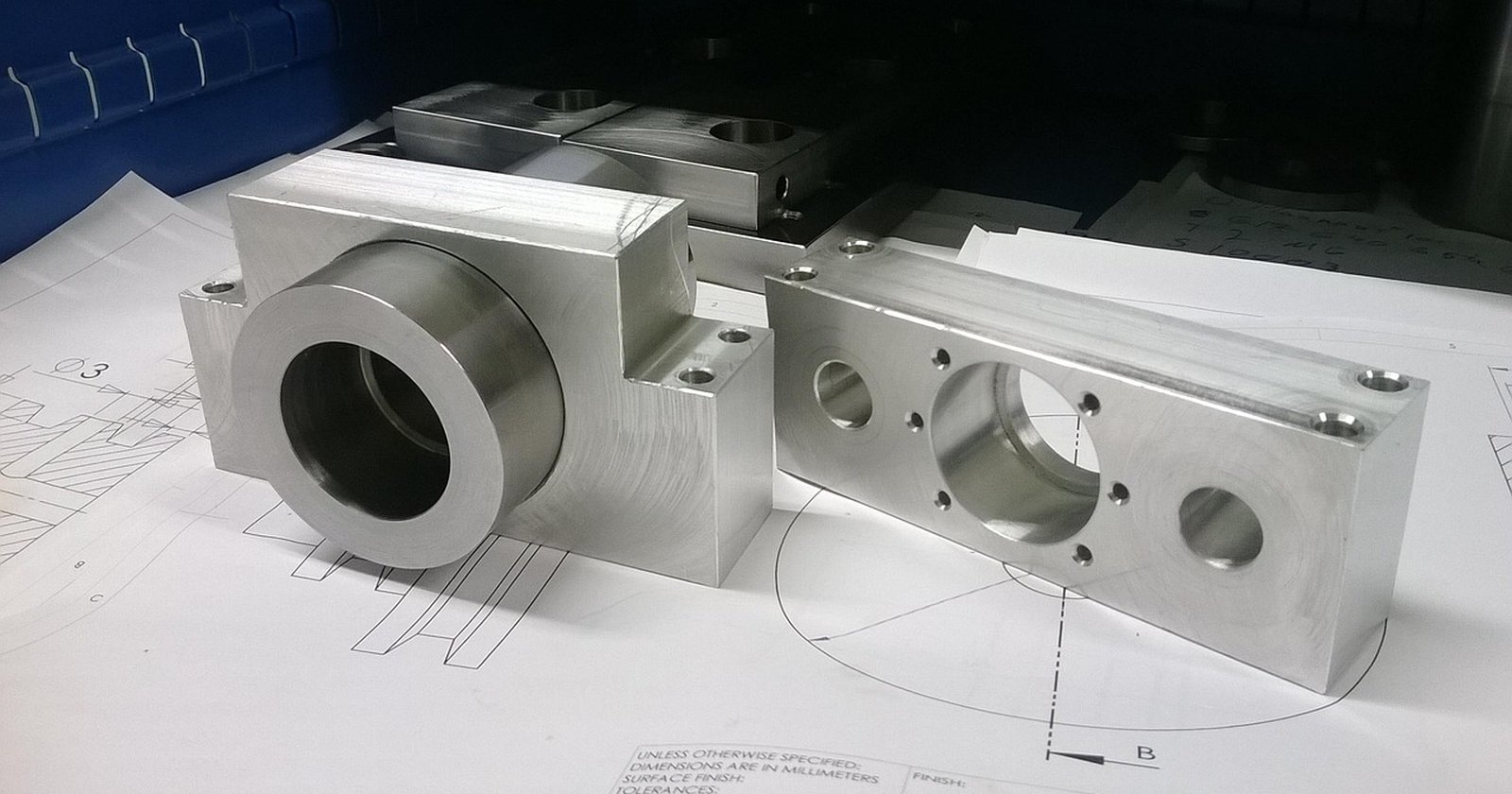
Many parts can be made either way. A bracket, a housing or a manifold can be printed in nylon or machined from aluminium, and both routes can produce a good part. The better choice depends on how many you need, what the part is made of, its shape, the tolerances that matter, the finish and how soon you need it. This guide works through each of those, then covers the common case where the answer is both.
Quantity
3D printing needs no tooling and almost no set-up, so the first part costs about the same as the tenth. That makes it strong for one-offs, prototypes and small batches, and for designs that are still changing. CNC machining carries a set-up cost for programming and fixtures, which is spread across the batch, so the price per part falls as the quantity rises. As quantities grow, machining often becomes the more economical route, though where the crossover sits depends on the part, the process and the material. Ask both kinds of supplier to price the same quantities, for example 1, 10 and 100, and the comparison becomes clear.
Material
Machining works from solid bar, plate or forging in a recognised grade, such as 6082 aluminium or 316 stainless steel, so the part has the properties on that grade's data sheet. Printing uses materials made for the process: nylons, resins and engineering thermoplastics for polymer parts, and powders of stainless steel, aluminium, titanium and nickel alloys for metal parts. Printed materials can perform very well, but their properties depend on the process and can differ by build direction. If your part must be a specific named grade, machining is usually the simpler route. If a printable material meets the requirement, both are open.
Geometry
Printing builds a part layer by layer, so it can make internal channels, lattices, organic shapes and several parts combined into one, none of which a cutting tool can reach. Machining needs tool access: deep narrow pockets, sharp internal corners and enclosed cavities add cost or are not possible. If the shape is the reason the part works, such as conformal cooling channels or a lightweight lattice, printing may be the only practical route. If the part is prismatic or round, machining handles it well.
Tolerances
Machining holds tighter tolerances than most print processes as a matter of course. Printing tolerances vary by process, material, size and build orientation. Published service guides for polymer powder bed processes, for example, quote figures in the region of ±0.3% with a lower limit of about ±0.3 mm, while machining suppliers routinely work to hundredths of a millimetre on critical features. Check the figures with your supplier for your part. Where a printed part needs a tight bore, a flat sealing face or a thread, those features can be machined after printing.
Surface finish
A machined surface is smooth and consistent from the cutter. Printed surfaces show layer lines or a grainy texture depending on the process, and support marks where supports were removed. Finishing such as bead blasting, dyeing, vapour smoothing, painting or polishing can improve the look and feel, and adds time and cost. If appearance matters, ask for a sample.
Lead time
For a small number of polymer parts, printing is often quick because there is no programming of toolpaths or fixtures to make. Machining a simple part can also be quick in a shop with spare capacity. For both, finishing, inspection and paperwork add time. Ask each supplier for a lead time that includes everything you need with the parts.
When to use both
Many projects use both routes at different stages:
- Print the prototype, machine the production run. Printed prototypes let you test form and fit quickly and change the design cheaply. Once the design is settled, machining in the production material gives you the final properties and tolerances.
- Print, then machine critical features. Metal printed parts often have bores, faces and threads machined after printing. This gives you printed geometry with machined accuracy where it matters.
- Print the fixtures. Printed jigs, fixtures and soft jaws can hold machined parts during manufacture and inspection.
If your prototype will become a machined part, design it with machining in mind from the start, so the step to production needs as few changes as possible.
Questions to ask
- What process and material would you use, and what tolerance can you hold on my critical features?
- How does the price change at 1, 10 and 100 parts?
- Which finishing steps are included in the price?
- Can you machine critical features after printing, in-house or through a partner?
- If the design moves to machining later, what would you change now to make that step easier?
Quick-reference checklist
- Write down the quantity now and the quantity you expect later
- State whether the material must be a named grade
- Mark the tolerances and surfaces that matter
- Ask for prices from both a print bureau and a machine shop at the same quantities
- Agree finishing and inspection up front
- Print the prototype and machine the production run where that suits the part
Where to go for more
Our guide to SLS, MJF, SLA, FDM and metal printing explains what each process does well, and our guide to choosing a UK 3D printing service covers the questions to ask a bureau. For machined parts, CNC Directory lists 300+ UK machining companies, including CNC milling, prototyping and rapid machining and machine shops that also offer 3D printing.
Find 3D printing companies on 3DP Directory
Browse the 30 UK 3D printing companies on 3DP Directory by process: polymer powder bed (SLS and MJF), resin printing, FDM and FFF and metal 3D printing. Several also offer CNC machining. Save the companies that fit to your shortlist and send one enquiry to the whole shortlist at once.
For press enquiries about 3DP Directory, contact 3dp@3dpdirectory.co.uk.
Listings related to this article

Amalgam Modelmaking Ltd
Bristol
Amalgam Modelmaking is a model-making and prototyping company in Bristol that 3D prints parts and sub-structures on an in-house Objet 350 printer, using VeroClear and other Objet resins at 16μm resolution. Printed parts are hand finished and used in their own right or as masters for polyurethane vacuum casting, including overmoulded parts. The company also runs on-site CNC machining, 3D scanning with an Artec Space Spider for reverse engineering, and CAD design. It holds Cyber Essentials and works for architects, naval architects, product designers, film and TV producers, museums and renewable energy suppliers, from prototypes to short production runs.
- PolyJet
- Vacuum Casting
- 3D Scanning
- Reverse Engineering

ARRK Europe
Gloucester, Gloucestershire
ARRK Europe runs an additive manufacturing centre in Quedgeley, Gloucester, producing prototypes and low-volume parts by SLA, SLS, HP MJF, DLP, PolyJet and continuous fibre printing. Materials include PA11 and PA12 nylon, TPU, tough and biocompatible DLP resins, and carbon fibre composites. Alongside printing it offers vacuum casting, CNC machining, 3D scanning and reverse engineering, with DyeMansion dyeing, AMT vapour smoothing, spray painting and electroforming. The Gloucester site holds ISO 9001 and ISO 14001, and the company is JOSCAR registered and Cyber Essentials certified. It serves defence, aerospace, automotive, medical and consumer products sectors.
- SLA
- SLS
- MJF
- DLP

CA Models
Stirling, Stirling
CA Models is a rapid prototyping and precision engineering company at Springkerse Industrial Estate, Stirling, established in 1983. It runs SLA, SLS, FDM, PolyJet and metal laser sintering (DMLS) in-house, alongside 5-axis CNC milling, turning, wire erosion, vacuum casting and a model shop. Materials include AlSi10Mg aluminium, 316L stainless steel, Ti6Al4V titanium, nylon, glass-filled nylon and Carbonmide, with in-house spray painting, CMM inspection and 3D scanning. The company holds ISO 9001 and Cyber Essentials, is JOSCAR registered, and works with aerospace, defence, automotive, Formula 1, medical device and oil and gas customers.
- SLA
- SLS
- FDM/FFF
- PolyJet
Cranford Engineering Ltd
Ashtead, Surrey
Cranford Engineering is a toolmaking and precision engineering business in Ashtead, Surrey, that offers 3D scanning, design and printing alongside CNC turning and milling, spark erosion and welding. Its print room runs a Bambu Lab H2S, a Formlabs 3a, two Markforged Onyx Pro printers and a Markforged Mark Two, producing parts in Onyx, a micro carbon fibre filled nylon, with continuous fibre reinforcement for added strength. In-house CAD/CAM turns 2D drawings into 3D models, and the workshop also handles reverse engineering and bespoke part manufacture. Customers include automotive repair specialists, race car and race bike teams, industrial prototypers, model makers and members of the public.
- FDM/FFF
- Design/CAD
- CNC Machining
- Reverse Engineering

Laser Prototypes Europe
Belfast, County Down
Laser Prototypes Europe (LPE) is a 3D printing and rapid prototyping bureau in Belfast, Northern Ireland, established in 1991. In-house processes include SLA, SLS, DLP and metal printing (DMLS) in titanium, aluminium, stainless steel, maraging steel and Inconel, alongside vacuum casting, 3- and 5-axis CNC machining and 3D scanning. The company holds ISO 9001, ISO 13485 and AS9100 certification and can supply first article inspection reports, CMM reports and material traceability for low-volume production. It serves medical, aerospace, defence, automotive, motorsport, consumer goods, film and architecture customers.
- SLS
- SLA
- DLP
- Metal LPBF/DMLS

Paragon Rapid Technologies
Darlington, Durham
Paragon Rapid Technologies is a prototyping and low-to-mid volume manufacturer based at Teesside International Airport, Darlington, County Durham. In-house 3D printing covers large-bed SLA with an 800 x 800 x 600 mm build size, SLS, HP Multi Jet Fusion and Carbon DLS, alongside vacuum casting, RIM moulding, CNC milling and turning, model making and CAD and reverse engineering support. The company is ISO 9001 certified and works across aerospace, defence, automotive, motorsport, medical, marine, energy, consumer products, industrial and film and television projects.
- SLA
- SLS
- MJF
- Large-Format Printing

Prototype Projects
Royston, Hertfordshire
Prototype Projects is a family-run prototyping bureau in Royston, Hertfordshire, established in 1980. In-house 3D printing covers SLA, including an SLA 750 with a 750 x 750 x 550 mm platform, SLS in PA12 nylon, DLP, PolyJet, micro SLA and filament printing in PLA, PETG and ABS, alongside CNC machining, vacuum casting and injection moulding. Finishing includes bead blasting, priming, painting, lacquering, SLS dyeing and vapour smoothing, with CMM inspection and inspection reports. The company holds ISO 9001, ISO 14001 and Cyber Essentials, is JOSCAR registered, and serves medical, aerospace and defence, industrial and consumer products customers.
- SLA
- SLS
- DLP
- PolyJet

WeDo3DPrinting (We Do Retail Ltd)
Sheffield, South Yorkshire
WeDo3DPrinting is a 3D printing and design service in Sheffield, run as a division of We Do Retail Ltd. It runs a print farm of over 50 machines, including large-format FDM printers that build parts over 1 metre, alongside SLA and SLS printing. FDM materials include PLA, ABS, ASA, PETG, polycarbonate and TPU, with nylon for SLS. Services cover CAD design, 3D scanning and reverse engineering of obsolete parts, plus 3-, 4- and 5-axis CNC machining and laser cutting. Work ranges from express single prototypes to batch production runs, and architectural models.
- FDM/FFF
- SLA
- SLS
- Large-Format Printing